Before buying, identify the actual flat-tire equipment supplied with the car
A neat cargo floor does not tell you what happens after a tire problem. Before choosing a vehicle, identify whether the actual car includes a spare, a temporary repair kit or another documented support arrangement. The useful comparison concerns equipment and limitations, rather than an assumption that every car carries the same solution.
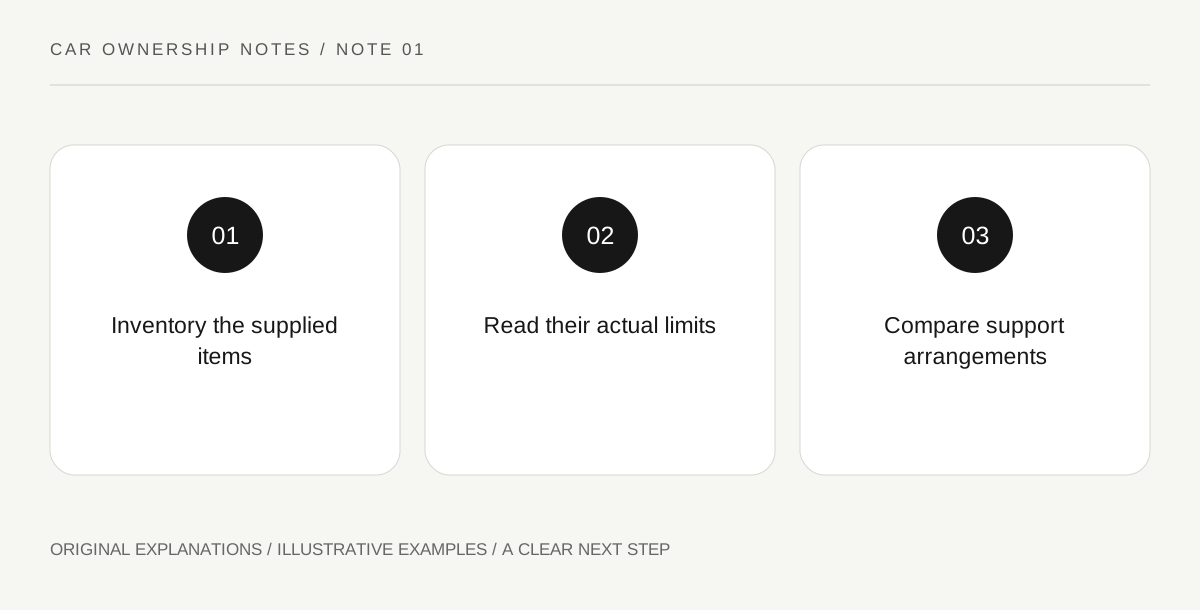
Original explanatory diagram. Read the full method and limitations below.
Make a physical and documentary inventory
Ask the seller to identify the supplied equipment while the vehicle is safely stationary, then match it with the correct owner documentation. Record included items and anything missing or optional. Do not assume an accessory shown in an online demonstration is supplied with this particular car. A spare-wheel well, an empty storage recess and an actual usable equipment set are different observations. Keep the inventory factual instead of treating an attractive storage layout as proof of preparedness.
Read temporary as a meaningful limitation
The cited Tesla Model S manual is one specific example of a temporary tire-repair kit with defined damage limitations and sealant expiry. It is not a universal solution or a procedure for other vehicles. For the car you are considering, read the actual manual and ask a qualified provider what the supplied arrangement can and cannot address. This article does not teach roadside repair or recommend driving on a damaged tire; it helps you identify the question before ownership.
Include replenishment in the comparison
Ask how consumable items are replaced, where the correct replacement can be obtained and whether the supplied item is within its usable period. If a seller offers a separately priced kit, compare its actual compatibility and contents rather than just the box’s existence. An inexpensive-looking accessory can still be irrelevant to the vehicle. Write down the correct part or specification from an authoritative source so that a later purchase is based on the actual requirement.
Connect the equipment to support
Read any roadside-assistance arrangement separately from the physical equipment. Who is contacted, what service is described and what limitations apply? Keep those answers in the ownership notebook without assuming that an assistance logo promises every kind of recovery or immediate availability everywhere. If the arrangement does not suit how you expect to use the vehicle, resolve that question before selecting it. The car’s purchase comparison becomes clearer when an unexamined emergency assumption is made visible.
An illustrative ownership comparison
Imagine two fictional used cars at similar prices. One seller documents the included spare arrangement; the other identifies a temporary kit with an expired consumable. A buyer records the missing replacement requirement and obtains a compatible-item quote before deciding. This is an invented inventory example, not a recommendation of either equipment type, an actual price comparison or a roadside repair assessment.
Questions that come up
Can a repair kit handle every tire problem?
No. Read the actual kit and vehicle instructions and obtain professional advice. The manufacturer example has specific limits; this article offers no general repair procedure or permission to keep driving with damage.
Does an empty storage recess prove equipment is missing?
Not by itself. Vehicles can have different factory arrangements. Match the actual specification, owner documentation and seller’s written inventory before deciding what should be present.
References and scope
These sources support the factual background. Examples and exercises are original illustrative teaching material. References do not imply endorsement.
- Tesla Model S manual — temporary tire kit — A specific example of temporary kit limitations and sealant expiry, not universal repair instructions.