A low-mileage car still needs a tire-age question
Low mileage can make a used car attractive without explaining the age of its tires. Before choosing it, ask a tire professional to help identify the set’s manufacturing information and assess its condition. Keep age and visible tread as different questions instead of treating unused-looking rubber as a complete answer.
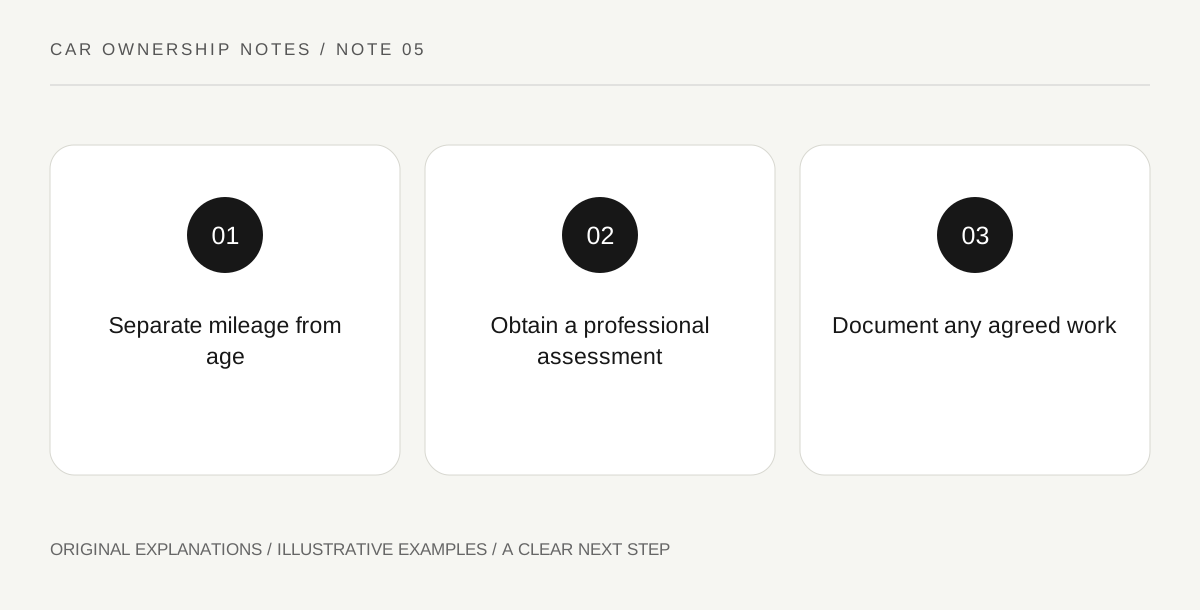
Original explanatory diagram. Read the full method and limitations below.
Separate the car’s use from the tire’s history
NHTSA explains that tires change with time, service, storage and environmental exposure. A car’s odometer is therefore not a manufacturing date for its tires. Ask what information is available for the actual set, including the spare where fitted. Do not assume every tire was fitted at the same time or that an apparently original set is automatically suitable. The purchasing notebook should preserve the distinction between vehicle mileage and the tire information being assessed.
Record identification without pretending to inspect
NHTSA describes manufacturing week and year information within the Tire Identification Number. Ask a qualified professional to identify and explain the actual markings if you are unfamiliar with them. Record what was established and who assessed it. Looking at a date is not the same as diagnosing the tire’s condition, and age alone does not describe every relevant factor. This guide does not set a universal replacement deadline or provide a substitute for manufacturer instructions and professional evaluation.
Keep a replacement question concrete
If the professional identifies a replacement need, obtain a compatible, complete service quote for the actual vehicle requirements. Separate that quote from an unsupported discount estimate based on appearance. Ask whether the seller will complete the agreed work or whether it remains your responsibility, and put any agreement in writing. The issue can be part of a rational ownership comparison without becoming a claim that low-mileage vehicles as a category are poor choices.
Treat the spare as part of the set’s story
A seldom-used spare can still have an age history. Identify whether one is supplied and ask about its applicable instructions and condition. Do not assume it is a fresh replacement simply because it has spent time out of sight. Once the question is resolved, keep the documentation with the vehicle’s ownership records. The outcome is a clearer handoff and future reference, not a promise about how many more miles any tire will deliver.
An illustrative ownership comparison
Imagine a lightly driven fictional car whose tire tread looks substantial. A professional identifies different manufacturing dates across the set and explains which further assessment is needed. The buyer records that information and obtains any relevant compatible replacement quote before proceeding. This illustrative scenario gives no universal age threshold, real diagnosis, market price or claim that visible tread establishes suitability.
Questions that come up
Does deep-looking tread establish that a tire is suitable?
No. NHTSA identifies aging and other considerations beyond tread appearance. Use the manufacturer’s guidance and a qualified professional’s assessment for the actual tire and circumstances.
Does this guide specify a replacement age for every tire?
No. Requirements and conditions vary. The exercise is to ask and document the age-and-condition question before buying, without inventing a universal deadline or diagnosing from a photograph.
References and scope
These sources support the factual background. Examples and exercises are original illustrative teaching material. References do not imply endorsement.
- NHTSA — TireWise — Tire specifications, aging, identification and professional inspection context.