When changing cars, plan the digital handoff as well as the physical one
Changing vehicles can leave personal data and remote-service links behind if the handoff stops at emptying the glove box. Before the transaction, make a manufacturer-guided plan for the old car’s stored information, connected accounts and subscriptions. Keep those tasks separate so that a single reset is not mistaken for complete account separation.
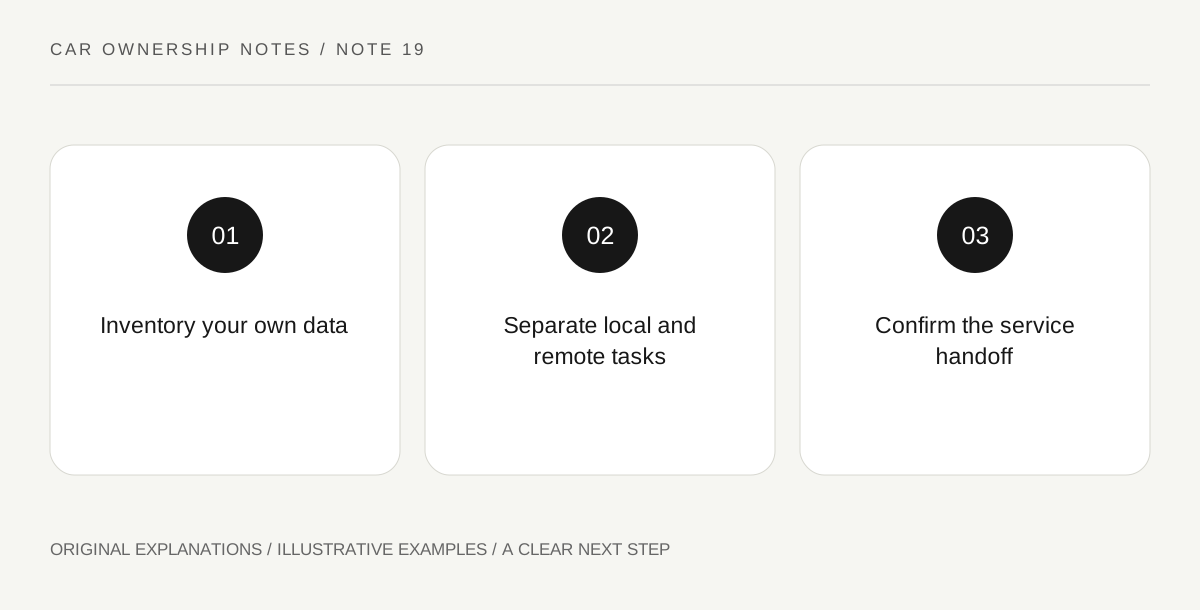
Original explanatory diagram. Read the full method and limitations below.
List the information categories
The FTC identifies contacts, saved locations, application data and garage-related information as examples that may remain in a vehicle. Make a private checklist of relevant categories without putting sensitive details into a public note. Ask the manufacturer’s instructions what the actual system stores and how the legitimate owner manages it. Do not assume the absence of a paired phone removes every stored item. The aim is an orderly handoff of your own information, not access to data belonging to someone else.
Separate local data from remote links
The FTC warns that a factory reset can leave separate subscription or account work to do. List the vehicle’s local-data process in one row and the legitimate owner account or remote-service disconnection in another. Follow the applicable instructions for each. A clean-looking display does not establish that every remote relationship has ended. Conversely, removing a service from a phone does not prove that all information stored in the car has been addressed.
Preserve what you legitimately need first
Before following the actual removal process, identify any personal record you need to retain in your own secure possession and confirm the scope of the manufacturer’s action. Do not erase safety, ownership or service information indiscriminately because a generic checklist says reset. If the instructions are unclear, ask authorized support before the handoff. The process should be deliberate and applicable to your system rather than an improvised sequence copied from a different model or software version.
Keep continuing services visible
Read how subscriptions are cancelled or legitimately transferred and obtain the actual confirmation where appropriate. Keep the old and new vehicle identities distinct during any transfer so that a service is not assumed to follow automatically. The physical key exchange, local data handling and remote account separation can be related tasks with different completion evidence. A clear handoff note states which has been completed and which remains pending without exposing private account details to the next owner.
An illustrative ownership comparison
Imagine a seller preparing a fictional connected car for transfer. They use the actual manual for local-data handling, separately follow the legitimate remote-account process and check the subscription confirmations. Their private checklist records completion without including passwords or saved addresses. This invented scenario gives no reset procedure, guarantees no universal removal method and does not authorize changing another person’s account.
Questions that come up
Does a factory reset necessarily cancel every subscription?
The FTC notes that separate work may remain. Check the actual provider’s account and service instructions rather than extending one reset action into a universal claim.
Can I inspect the previous owner’s stored information while shopping?
Do not use another person’s private data. Ask the seller to arrange an appropriate legitimate handoff and account separation; this guide concerns managing your own information before transfer.
References and scope
These sources support the factual background. Examples and exercises are original illustrative teaching material. References do not imply endorsement.
- FTC — remove personal data before selling a car — Stored personal data, remote account links and subscriptions can require separate handoff steps.