For an EV battery warranty, ask which event the written coverage addresses
A battery-warranty headline does not tell you how every future change in battery behavior will be treated. Before choosing an EV, read the actual coverage and ask which events, measures and processes it addresses. Keep warranty wording separate from an informal estimate of how the car seems to perform today.
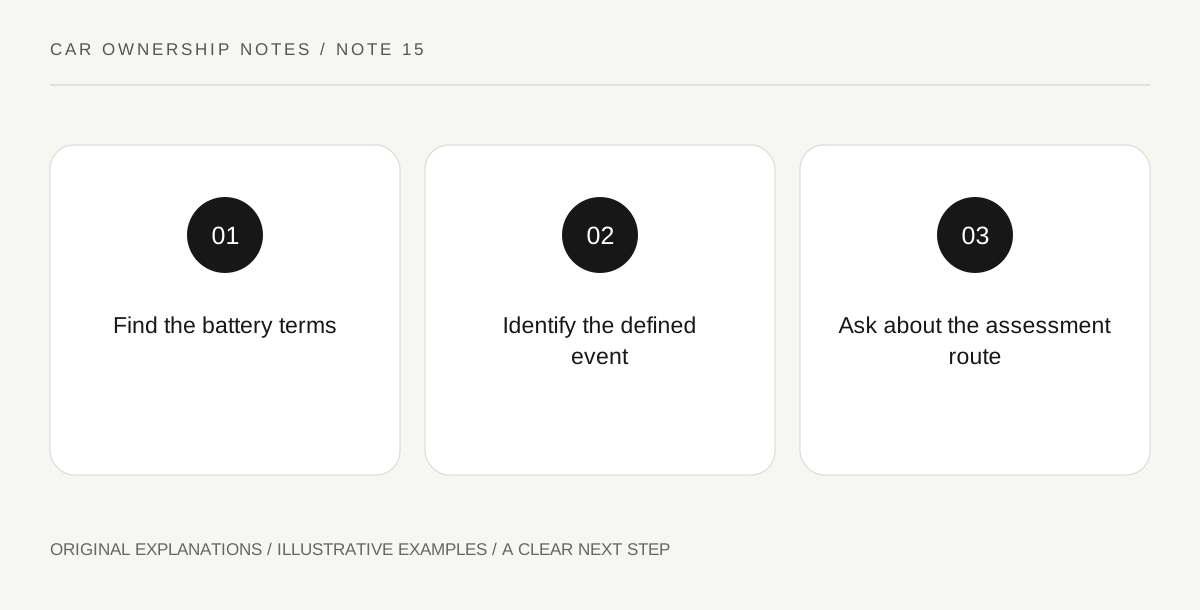
Original explanatory diagram. Read the full method and limitations below.
Find the vehicle-specific battery document
AFDC advises buyers to ask about battery life and warranties and consult the manufacturer’s information. Obtain the actual terms for the car being considered rather than substituting a commonly advertised industry period. Record the covered component and any applicable start, time and mileage information. A generic statement about EV batteries cannot establish remaining coverage on a particular used vehicle, and another market’s document should not silently become the governing text for this sale.
Ask what kind of event is described
Read whether the actual document addresses defects, a defined capacity measure, another specified condition or a combination. Do not assume those words are interchangeable. Ask the appropriate provider to identify the relevant provision and explain unfamiliar terminology. This guide does not set a capacity threshold or claim that ordinary range variation qualifies for a repair. It helps a buyer notice that the event being covered matters as much as the large year count in a headline.
Keep observations separate from measurement criteria
A seller’s range display, a previous owner’s recollection and a manufacturer-defined assessment can provide different information. Record each by its actual source without converting one into another. A displayed estimate is not automatically the measurement used by a warranty process. If the battery’s condition matters to your selection, ask an appropriately qualified provider about a suitable assessment and its limits. Do not diagnose the battery or infer an entitlement from one number observed during a short viewing.
Understand the legitimate assessment route
Ask whom an owner contacts, what information the actual process requests and how the provider evaluates the relevant event. Keep any eligibility question open until it is properly answered. A pre-purchase notebook should preserve the written terms and relevant assessment information, not promise a future replacement. If the documentation cannot support a claim made in the listing, request clarification before deciding how much weight to place on that claimed benefit.
An illustrative ownership comparison
In an invented listing, a seller describes a battery as covered for years and points to a displayed range estimate. The buyer obtains the applicable document and asks how its defined event would be assessed, keeping the display separate. The scenario supplies no actual threshold, diagnosis, replacement promise or claim outcome; it demonstrates reading the coverage rather than extending a headline.
Questions that come up
Does a lower displayed range prove a covered battery defect?
No. This guide makes no diagnosis or coverage determination. Ask a qualified provider about the relevant observations, actual warranty definition and appropriate assessment.
Does an industry-standard-sounding period establish my coverage?
No. Use the actual vehicle’s applicable terms and start record. A general example from another vehicle or market does not establish eligibility or remaining protection for yours.
References and scope
These sources support the factual background. Examples and exercises are original illustrative teaching material. References do not imply endorsement.
- US Department of Energy AFDC — EV maintenance — All-electric maintenance differs from hybrids; battery warranty and service requirements remain vehicle-specific.