A certified label needs a named program and an actual warranty document
Certified is an attractive word in a used-car listing, but the ownership question concerns the actual program and written terms. Before choosing the car, identify who makes the certification claim and which document describes any resulting coverage. An adjective cannot do the work of a named, applicable arrangement.
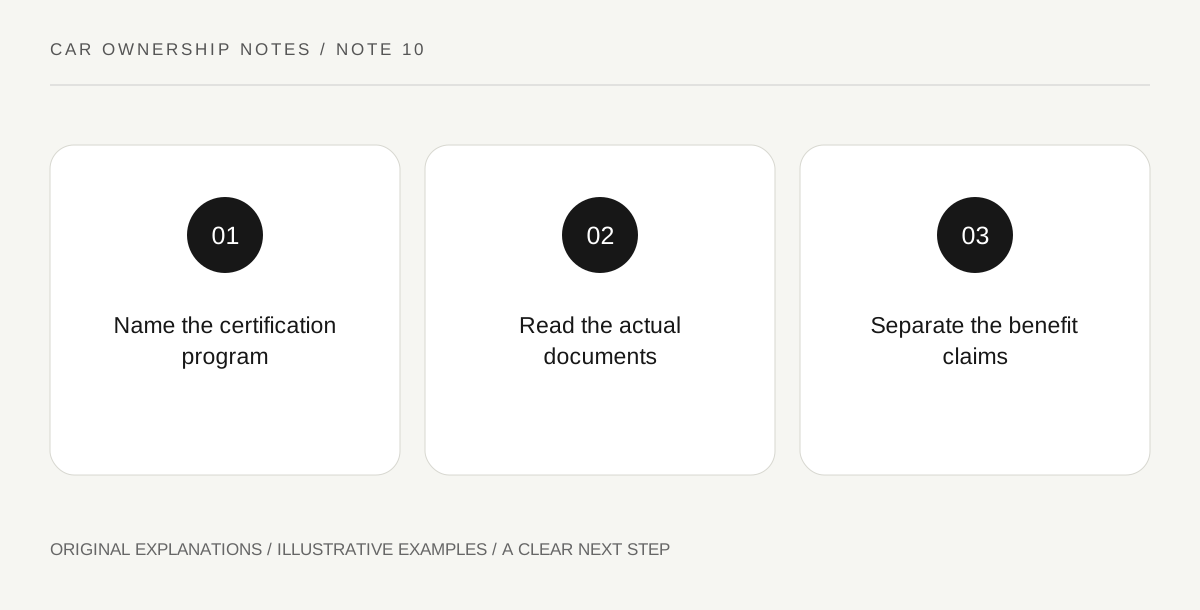
Original explanatory diagram. Read the full method and limitations below.
Name the party behind the label
Ask the seller to identify the exact certification program and the organization responsible for it. Keep a manufacturer-backed program distinct from a seller’s own description without assuming either label establishes the same terms. Write the actual program name, vehicle identity and document date together. This creates a concrete question that another person can review. A logo or a general explanation of what certified cars often include is not an answer about this particular offered vehicle.
Read the Buyers Guide beside the program text
The FTC describes the Buyers Guide’s role in disclosing whether a dealer’s used vehicle is sold with a warranty or as is, and advises getting promises in writing. Obtain the applicable documents and ask for any inconsistency to be clarified before committing. Do not invent a universal coverage period from the certification word. The actual warranty category, responsible provider and stated limits belong in the ownership comparison, even when the sales page uses a much shorter summary.
Keep different claims in different rows
A program may describe an inspection, coverage and other benefits as separate elements. List what the actual documents say for each without turning one element into proof of the others. A covered repair category does not certify that every part is currently faultless, and an inspection label does not automatically define a later claim process. Use qualified assessment for present condition and the actual written terms for coverage. The rows help prevent one appealing feature from swallowing all the unanswered questions.
Decide from the documented package
Compare the actual applicable arrangement with the alternative car’s documentation and your own priorities. Avoid assigning an invented cash value to a benefit that has not been defined. If a promised document is unavailable, preserve that as a material open question rather than assuming it will say what the advertisement suggests. The outcome can be a clearer request for information or a decision to wait, without making a universal judgment about every vehicle described as certified.
An illustrative ownership comparison
Imagine two fictional listings both using certified. One identifies a named program and supplies the applicable documents; the other has only a seller’s general label. A buyer asks the second seller for equivalent clarity instead of assuming identical benefits. This invented comparison supplies no assessment of either vehicle, no legal conclusion about a real sale and no warranty entitlement.
Questions that come up
Does certified always mean the same warranty?
No universal term is established by the adjective. Read the actual program and vehicle-specific documents rather than importing another seller’s or manufacturer’s terms.
Can coverage documentation replace a current condition assessment?
No. Coverage and condition are different questions. Keep any inspection or professional assessment separate from the written provisions governing a possible later repair claim.
References and scope
These sources support the factual background. Examples and exercises are original illustrative teaching material. References do not imply endorsement.
- FTC — buying a used car from a dealer — Buyers Guide warranty disclosure and written promises; a certification label does not replace the actual terms.