Less EV maintenance is a starting question, not a zero-service budget
An electric-car comparison can become misleading when less maintenance is shortened to no maintenance. Before choosing, ask for the actual vehicle’s schedule and local service arrangements. Keep an all-electric car distinct from a hybrid, then compare the tasks that remain instead of filling a budget with an invented zero.
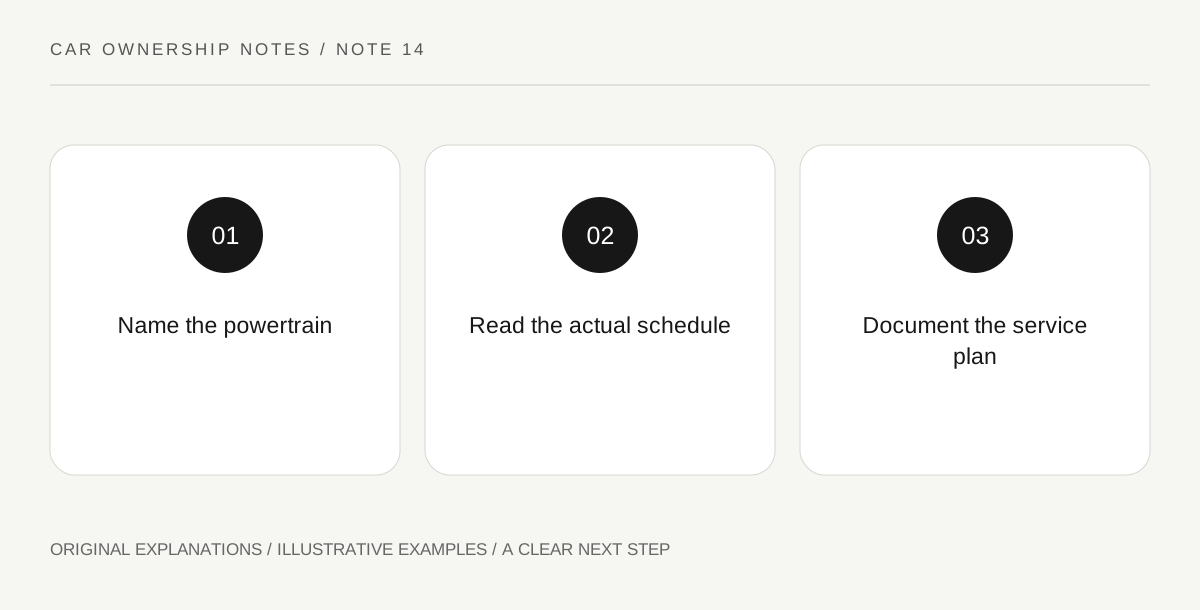
Original explanatory diagram. Read the full method and limitations below.
Identify the powertrain category
The Department of Energy’s AFDC distinguishes all-electric maintenance from hybrid and plug-in-hybrid maintenance, which still involves an internal combustion engine. Label the actual vehicle correctly before using a broad electric-car claim. A plug and a battery do not make every vehicle’s maintenance schedule identical. Ask for the manufacturer’s document applicable to the model, year, powertrain and market. The category helps you find the right questions but does not establish every task or interval on its own.
Build a task list from the document
Record the actual scheduled categories and any conditions the manufacturer says affect them. Do not copy a familiar combustion-car schedule into an all-electric worksheet or delete tasks based on a promotional phrase. Keep inspection and replacement as different activities where the document distinguishes them. If a term is unclear, ask a qualified provider to explain it. This guide organizes the schedule; it does not tell you to service high-voltage components or improvise a maintenance procedure.
Ask about the service arrangement
Find which appropriate qualified facilities can support the particular car and how an ordinary appointment is arranged. Ask for current quotes only for clearly defined tasks and keep their scope visible. A lower number of routine tasks does not answer every question about location, booking, transport during service or future unscheduled work. Record those as separate ownership considerations rather than trying to compress them into a universal claim that electric ownership is always easier or cheaper.
Use a visible budgeting assumption
When comparing ownership plans, label any illustrative service allowance as your assumption rather than a measured average or guaranteed saving. Replace it with applicable information as it becomes available. Avoid assigning zero to every unspecified line: an unknown cost and a confirmed absence of a task are different. The useful outcome is a realistic set of questions and documented services, allowing the powertrain choice to be discussed without a maintenance slogan doing all the work.
An illustrative ownership comparison
Imagine a buyer comparing a fictional all-electric car with a plug-in hybrid. They request each correct maintenance document and keep the hybrid’s engine-related tasks in its own list. A blank quote remains unknown rather than zero. The example is an invented worksheet exercise and supplies no service interval, price, lifetime saving, technical instruction or assessment of a real vehicle.
Questions that come up
Does less routine maintenance mean no service needs?
No. Use the actual manufacturer schedule and qualified service guidance. The broad comparison does not remove remaining tasks or establish that every future repair cost is zero.
Can I use another electric model’s schedule?
Do not assume it applies. Model, year, powertrain and market can matter. Find the correct document and ask the appropriate provider about the actual vehicle rather than treating a general category as a complete schedule.
References and scope
These sources support the factual background. Examples and exercises are original illustrative teaching material. References do not imply endorsement.
- US Department of Energy AFDC — EV maintenance — All-electric maintenance differs from hybrids; battery warranty and service requirements remain vehicle-specific.