Save the right owner manual: model name alone is not enough
An owner manual is most useful when it applies to the car in front of you. Before choosing, identify the correct model year, market and relevant equipment context, then save the official reference. A familiar model name can otherwise lead to an attractive explanation of a feature that this particular vehicle does not have.
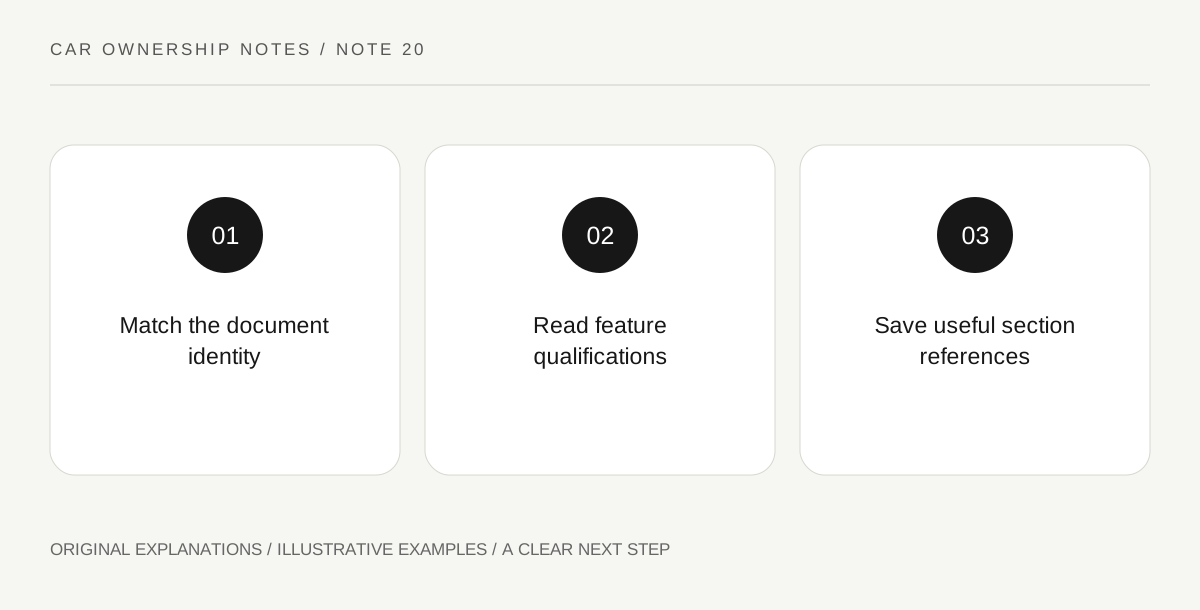
Original explanatory diagram. Read the full method and limitations below.
Start with the document identity
Manufacturer manual directories organize vehicles by model and model year; the cited Ford Caribbean directory is one example. Its regional content does not establish the manual for a U.S. vehicle. Use the actual manufacturer’s appropriate market source and confirm the vehicle identity with legitimate documents. Do not choose the first search result merely because the cover has the same badge. The document’s title, applicable year and region belong in the ownership file alongside the link or saved official copy.
Check the feature qualification
Within the applicable manual, read any qualifications such as if equipped or version-specific availability. A manual can describe several configurations without proving every listed function exists in yours. Ask the seller to identify the actual equipment and use a suitable stationary demonstration where relevant. Keep that observation separate from the document’s general description. This prevents a search through a broad manual from accidentally upgrading the car’s specification in your own comparison notes.
Use a three-question reference test
Choose three ownership questions that matter to you, such as finding a documented warning explanation, identifying the supplied support equipment and locating a legitimate service-information route. Try finding their references in the correct official material without performing any repair or changing settings. The task tests whether you can navigate the information, not whether the vehicle passes a mechanical inspection. Record the relevant section names so they remain useful after the sales conversation ends.
Keep the reference current and private where needed
If the official system has updated electronic information, read how it relates to the supplied printed material and ask the manufacturer about any conflict. Avoid storing account credentials or unrelated personal documents with a public manual link. The final notebook should identify where reliable information comes from and which questions remain unresolved. A correct reference cannot answer every ownership decision, but it gives later questions a firmer starting point than a remembered video for a similar car.
An illustrative ownership comparison
In an invented viewing, a buyer first finds a manual for the right model name but the wrong market and year. They replace it with the applicable official reference and discover that one described feature is qualified by equipment. They then ask about the actual car. This illustrative exercise provides no real specification, technical procedure or guarantee that a particular online document applies.
Questions that come up
Does a feature appearing in a manual prove this car has it?
No. The document may cover several configurations. Read its qualifications and confirm the actual equipment rather than converting a general description into a vehicle-specific claim.
Does the linked regional directory apply automatically to U.S. vehicles?
No. It illustrates document organization. Use the manufacturer’s correct source for the actual vehicle and market, and obtain clarification when the applicable reference is uncertain.
References and scope
These sources support the factual background. Examples and exercises are original illustrative teaching material. References do not imply endorsement.
- Ford Caribbean — owner-manual directory — Illustrates model and model-year manual selection; use the correct market documentation for the actual vehicle.