Ask for a readable maintenance handoff file rather than a pile of receipts
Maintenance records become more useful when their meaning can be followed. Before choosing a used car, ask what records are available and organize them by date, mileage and documented task. A readable file can expose a question to ask without pretending that paperwork proves the vehicle’s complete mechanical condition.
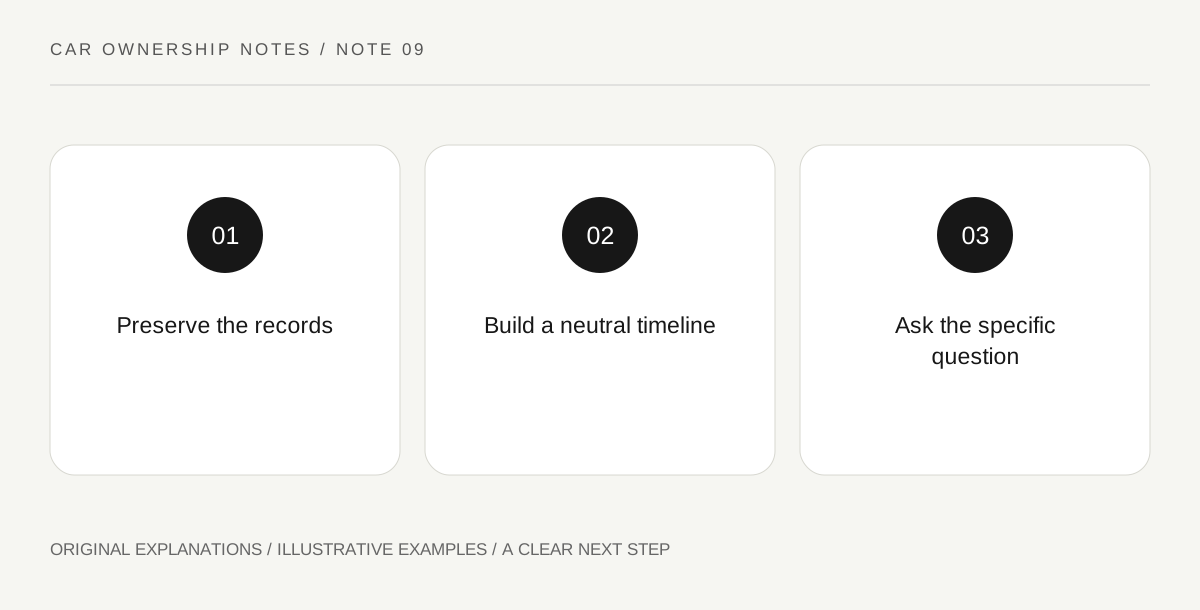
Original explanatory diagram. Read the full method and limitations below.
Preserve the original record
The FTC advises keeping maintenance records and receipts in the context of warranty and service-contract requirements. When reviewing records supplied with a used vehicle, retain the original wording and dates rather than rewriting them into a stronger claim. Ask for personal information unrelated to the vehicle to be appropriately removed before sharing. A service invoice, an owner’s recollection and a stamped summary provide different kinds of information; label them so that later readers can see the difference.
Create a neutral timeline
Use columns for the date, recorded mileage, stated task and source document. Keep a blank where information is absent. Do not invent an interval or fill an undocumented period with assumed regular service. A neutral timeline is easier for a qualified professional to inspect than a vague assurance that everything was always done. It can also reveal that two records refer to the same event, preventing a duplicate invoice from being counted as an additional service.
Match questions to the actual schedule
Find the correct manufacturer maintenance information for the vehicle and ask a qualified provider how it relates to the available record. Do not borrow another engine or model year’s schedule. A missing receipt does not by itself establish that a task was skipped, and an invoice does not prove that every required condition has been met. Keep the conclusion narrow: this task is documented, this period is unclear and this question needs an appropriate answer before selection.
Keep documentation separate from inspection
The file helps you understand ownership history, but it is not a substitute for a qualified current assessment. A car can have records and still require attention; it can also have an incomplete file without every gap representing a defect. Use the timeline to make professional questions more precise rather than diagnosing the vehicle yourself. If a seller promises additional documents or work, state that handoff separately and preserve the written agreement.
An illustrative ownership comparison
Imagine a seller supplying six receipts, two of which describe the same fictional visit. A buyer creates one timeline entry for that event, preserves an unclear period as a question and asks a qualified provider about the applicable maintenance information. They do not call the file a mechanical guarantee. The scenario is invented and supplies no diagnosis, service interval or warranty-entitlement decision.
Questions that come up
Does a full-looking file guarantee mechanical condition?
No. Records describe documented events and may have limits. Use an appropriate current professional assessment for the actual vehicle rather than treating paperwork as a complete all-clear.
Does a missing receipt prove maintenance was never done?
No. It identifies missing documentation. Ask for available clarification and keep the conclusion limited to what the record establishes instead of replacing uncertainty with an accusation or an optimistic assumption.
References and scope
These sources support the factual background. Examples and exercises are original illustrative teaching material. References do not imply endorsement.
- FTC — auto warranties and service contracts — Warranty and separately purchased service-contract distinctions, coverage periods, administrators and maintenance records.