Ask how temporary transport works if the car needs covered repairs
The inconvenience of a repair is not limited to the repair invoice. Before choosing a car and related coverage, ask what happens to your transport while it is unavailable. Keep a dealer courtesy vehicle, a paid rental and policy reimbursement separate, so that a friendly promise does not become an assumed guaranteed replacement car.
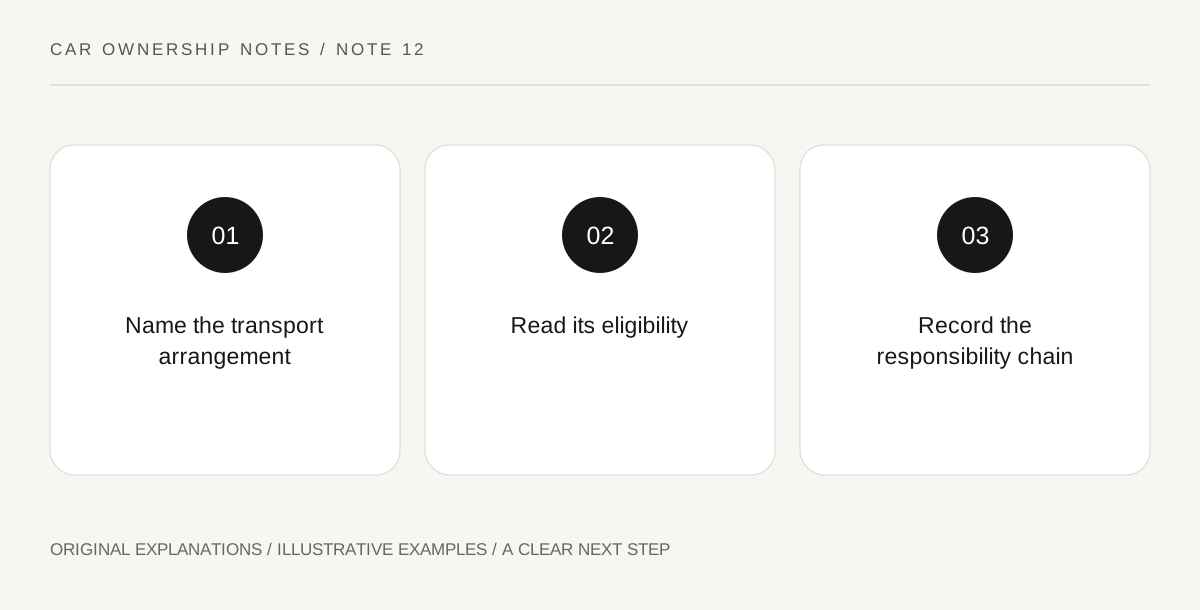
Original explanatory diagram. Read the full method and limitations below.
Name the arrangement being offered
Ask whether the seller is describing a courtesy loaner, an optional rental service or reimbursement under a particular policy or contract. Record the provider and actual written terms. These arrangements can have different eligibility and availability. Do not let the phrase we will look after you replace the practical question of who supplies transport and under which conditions. A car-selection notebook benefits from a concrete explanation even when the eventual repair scenario remains hypothetical.
Read the relevant policy limitations
NAIC explains that reimbursement under your own auto policy depends on purchased rental coverage and the policy’s limits. Ask the licensed provider how the actual terms apply, including the covered circumstances and relevant dollar or time boundaries. This article does not determine entitlement under a claim. A repair visit is not automatically the same event as a covered insurance loss, and a dealership’s service arrangement is not automatically an insurance benefit.
Consider the type of transport you actually need
A temporary vehicle or other arrangement must still meet the people’s practical needs. Before relying on a general promise, ask how availability, permitted drivers and any relevant size or equipment requirements are handled. Avoid inventing an assurance that an equivalent vehicle will always be supplied. You can also think through an independent short-term plan for an ordinary service appointment, keeping its cost assumption clearly separate from any benefit that would require a covered event.
Keep the responsibility chain readable
Write who arranges the transport, who pays initially and what documentation or authorization the actual terms require. If several organizations are involved, preserve their roles rather than assuming one automatically communicates with the others. A hypothetical plan should remain flexible until a real event and its eligibility are known. The purpose is to understand an ownership inconvenience before it happens, not to promise a claim outcome or recommend buying a particular extra coverage.
An illustrative ownership comparison
For an invented ownership scenario, a buyer discovers that a seller’s courtesy vehicle is subject to availability, while a separate policy reimbursement applies only under its own conditions. They record both and make a different plan for routine service. This fictional example supplies no real benefit, rental price, reimbursement period or determination of a claim under any policy.
Questions that come up
Does every service appointment trigger rental reimbursement?
Do not assume so. Read the actual policy or contract and ask the appropriate provider about eligibility. Routine maintenance, a warranty repair and an insured loss can involve different arrangements.
Does a courtesy-car promise guarantee an identical replacement?
No such guarantee is established here. Ask about the written terms, availability and the practical requirements that matter to your household before relying on the arrangement.
References and scope
These sources support the factual background. Examples and exercises are original illustrative teaching material. References do not imply endorsement.
- NAIC — consumer auto-insurance questions — Policy-specific rental reimbursement and own-policy claim limitations.